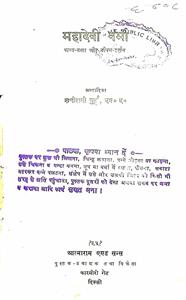
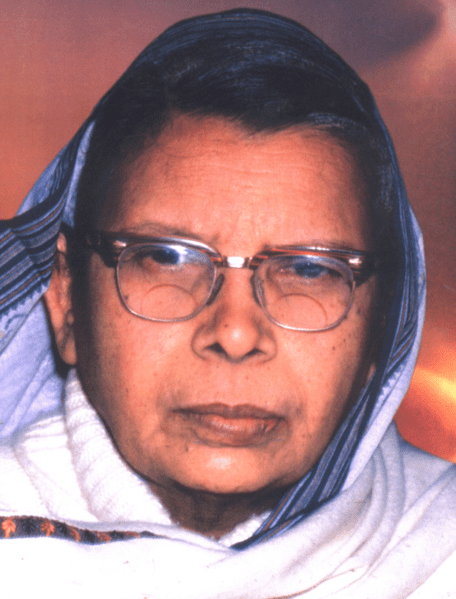
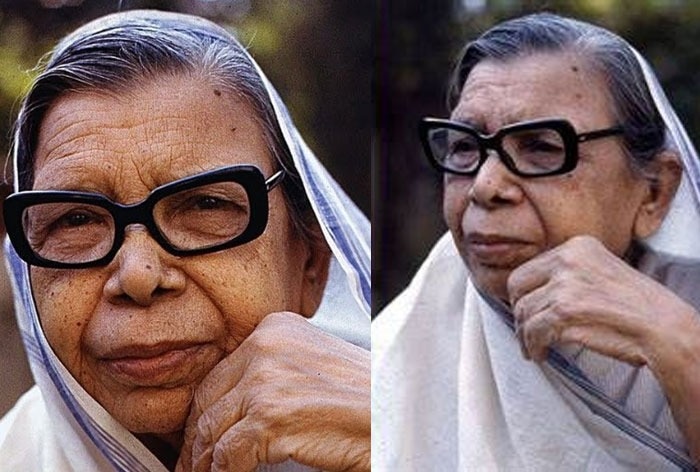
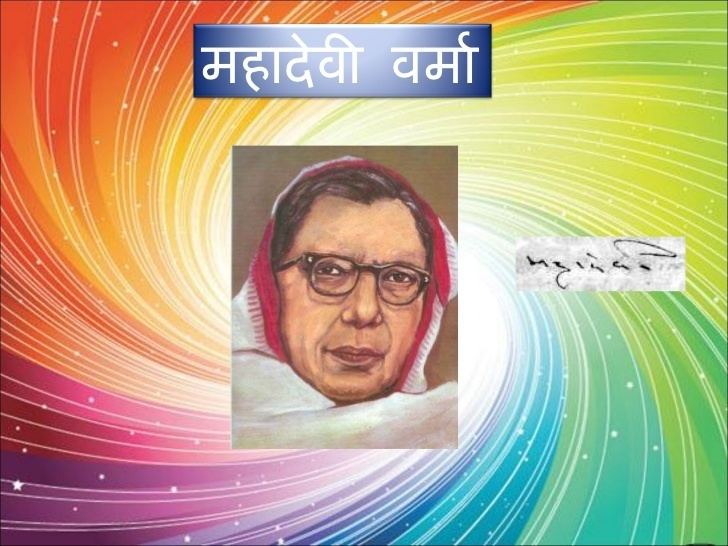
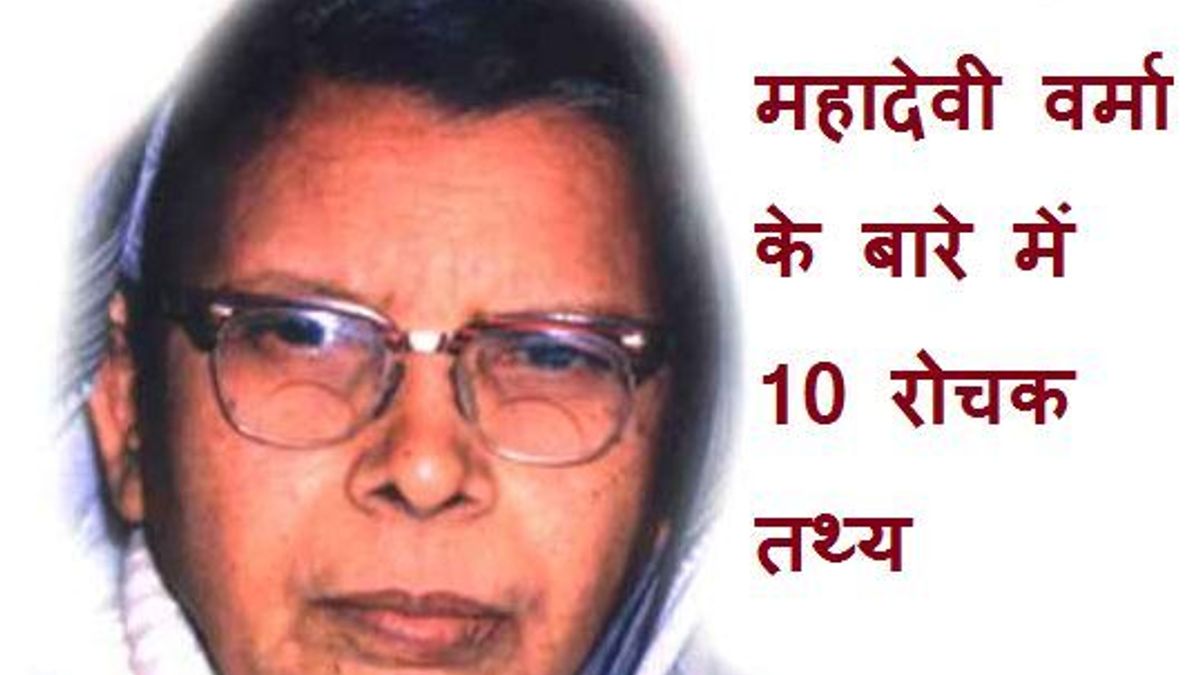
Mahadevi Verma (26 March 1907 – 11 September 1987) was an Indian Hindi-language poet, essayist, short story writer, and an eminent personality of Hindi literature. She is considered one of the four major pillars of the Chhayawadi era in Hindi literature. She has also been addressed as the modern Meera. Poet Nirala once called her "Saraswati in the vast temple of Hindi Literature." Verma witnessed India before and after its independence. She was one of those poets who worked for the wider society of India. Her work towards social upliftment and women's welfare was depicted in her writings. These works, especially her anthology Deepshikha, greatly influenced both readers and critics.
She developed a soft vocabulary in the Hindi poetry of Khadi Boli, which previously was considered possible only in Braj Bhasha. She was also well-versed in music, and her songs were characterised by a tone that conveyed sharp expressions in a nuanced and euphemistic style. She started her career as a teacher and went on to become the principal of Prayag Mahila Vidyapeeth. Verma chose to live an ascetic life, despite being married. She was also a skilled painter and imaginative translator. She had the rare distinction of receiving all the important awards in Hindi literature. As the most celebrated female writer of the last century, she remained highly revered throughout her life. Her birth centenary was celebrated in 2007. Later, Google also celebrated this day through its Google Doodle.
Life and education
Early life
Verma was born on 26 March 1907 in a Hindu Chitraguptavanshi Kayastha family of Farrukhabad, Uttar Pradesh, India. Her father, Govind Prasad Verma, was a college professor in Bhagalpur. Her mother's name was Hem Rani Devi; she was a religious, passionate, and vegetarian woman with a keen interest in music. Her mother would spend hours reciting Ramayana, Gita and Vinay Patrika. In contrast, her father was a scholar, music lover, atheist, hunting enthusiast, and cheerful person. Sumitranandan Pant and Suryakant Tripathi Nirala were close friends of Mahadevi Varma. It is said that for 40 years Varma tied Rakhi to Nirala.
Education
Verma was originally admitted to a Convent school, but upon protests and an unwilling attitude, she was admitted to Crosthwaite Girls College in Prayagraj (then Allahabad). According to Verma, she learned the strength of unity while staying in the hostel at Crosthwaite. Students of different religions lived together there. Verma started to write poems secretly; but upon discovery of her hidden stash of poems by her roommate and senior Subhadra Kumari Chauhan (known in the school for writing poems), her hidden talent was exposed.
While others used to play outside, me and Subhadra used to sit on a tree and let our creative thoughts flow together...She used to write in Khariboli, and soon I also started to write in Khariboli...this way, we used to write one or two poems a day...
She and Subhadra would also send poems to publications such as weekly magazines and managed to get some of their poems published. Both the budding poets also attended poetry seminars, where they met eminent Hindi poets, and read out their poems to the audience. This partnership continued until Subhadra graduated from Crosthwaite.
In her childhood biography, Mere Bachpan Ke Din (My Childhood Days), Verma wrote that she was very fortunate to be born into a liberal family at a time when girl children were considered family burdens. Her grandfather reportedly had the ambition of making her a scholar; although he insisted that she comply with tradition and marry at the age of nine. Her mother was fluent both in Sanskrit and Hindi, and was firmly devoted to religion. Mahadevi credits her mother for inspiring her to write poems and take interest in literature.
Having been wed as a child, Mahadevi was expected to live with her husband after her graduation in 1929, but she refused because she found his hunting and meat-eating offensive. Her remorseful father offered to convert along with her if she wanted to divorce and remarry (as Hindus could not legally divorce at the time) but she refused, saying she wanted to remain single. She even unsuccessfully tried to convince her husband to remarry. Later, she reportedly considered becoming a Buddhist nun but eventually chose not to, even though she studied Buddhist Pali and Prakrit texts as part of her master's degree.
Professional career
Literary
Nihar (IPA: Nīhār) was her debut collection of poems. She composed Nihar, Rashmi, Neerja in the years 1930, 1932, and 1933 respectively. In 1935, a collection of her poems titled Sandhyageet was published. In 1939, four poetic collections were published with their respective artworks under the title Yama. Apart from these, she had also written 18 novels and short stories, with Mera Parivar (My Family), Smriti ki Rekhaye (Lines of Memory), Patha ke Sathi (Path's Companions), Srinkhala ke Kariye (Series of Links) and Atit ke Chalachrit (Past Movies) being prominent among them. She is also considered the pioneer of feminism in India.
Women's advocacy
Varma's career had always revolved around writing, editing, and teaching, significantly contributing to the development of Prayag Mahila Vidyapeeth in Allahabad. This kind of responsibility was considered a revolutionary step in the field of women's education at the time. She also had been its Principal. In 1923, she took over the women's leading magazine Chand. In the year 1955, Varma established the Literary Parliament in Allahabad with the help of Ilachandra Joshi, and eventually took up the editorship of its publication. She laid the foundation for women's poets' conferences in India. Mahadevi was greatly influenced by Buddhism. Under the influence of Mahatma Gandhi, she took up public service and worked in Jhansi alongside the Indian freedom struggle.
In 1937, Mahadevi Varma built a house in the village of Umagarh, Ramgarh, Uttarakhand, 25 km from Nainital. She named it Meera Temple. She started working for the village people and their education till she stayed there. She did a lot of work, especially for women's education and their economic self-sufficiency. Today, this bungalow is known as Mahadevi Sahitya Museum. In the series of attempts, she was able to raise the courage and determination for the liberation and development of women.
The way she condemned social stereotypes made her known as a woman liberationist. She had also been called a social reformer due to her development work and public service towards women and their education. Throughout her creations, there are no visions of pain or anguish anywhere, but the indomitable creative fury reflected in the society's indomitable desire for change and an innate attachment towards development.
In Hindu, Stree Ka Patnitva (The Wifehood of Hindu Women) marriage is compared to slavery. Not being affiliated with any political or financial authority, she writes, women are assigned to lives of being wives and mothers. Her feminism is often overshadowed by her poetic persona. Through poems like Cha, she explored themes and ideas of female sexuality, while her short stories such as Biblia, discuss the subject of experiences of women's physical and mental abuse.
She spent most of her life in Allahabad (Prayagraj) of Uttar Pradesh. She died in Allahabad on 11 September 1987.
Works
Verma was a poet as well as a distinguished prose and story writer. Her creations are as follows.
Poetry
Several other poetic collections of Mahadevi Verma are also published, in which selected songs from the above compositions have been compiled.
Prose
List of selected prose works includes
Others
Two compilations of children's poems of Mahadevi Verma are
- Thakurji Bhole Hai
- Aaj Kharidenge hum Jwala
Critical analysis
A section of critics is those who believe that the poetry of Mahadevi is very personal. Her agony, anguish, and compassion, are artificial.
Moral critics like Ramchandra Shukla have put a question mark on the truth of her anguish and feelings. He quotes:
Concerning this anguish, she has revealed such sensations of heart, which are extraterrestrial. As far as these sensations are concerned and how far the sensations are real, nothing can be said. (English translation)
On the other hand, Hazari Prasad Dwivedi considered her poetry to be a collective criterion of emotions. Poetic works like Deep from (Nihar), Madhur Madhur Mere Deepak Jal from (Neerja) and Mome Sa Tan Gal Hai, concludes that these poems not only explain Mahadevi's self-centeredness but also to be considered a representative form of general posture and texture of her poems. Satyaprakash Mishra says about her philosophy of metaphysics related to cinematography:
Mahadevi did not only differentiate and distinguish from the earlier poetry of the object craft of Shadowism and Mysticism under rationalism and examples but also showed in what sense it is human. There is a poetry of change of sensation and newness of expression. She did not accuse anyone of sentiment, adoration etc. but only described the nature, character, appearance and uniqueness of Chhayavad. (English translation)
American novelist David Rubin has said the following about her works:
What arrests us in Mahadevi's work is the striking originality of the voice and the technical ingenuity which enabled her to create in her series of mostly quite short lyrics throughout her five volumes a consistently evolving representation of total subjectivity measured against the vastness of cosmic nature with nothing, as it were, intervening—no human social relationships, no human activities beyond those metaphorical ones involving weeping, walking the road, playing the Veena, etc.
Prabhakar Shrotriya believes that those who consider her a poet of anguish and despair do not know how much fire there is in that suffering which exposes the truth of life. He says:
In fact, the centre of Mahadevi's experience and creation is fire, not tears. What is visible is not the ultimate truth, what is invisible is the original or inspiring truth. These tears are not the tears of easy simple anguish, but how much fire goes behind them, the thunderstorm, the electric roar of the cloud, and the rebellion are hidden.
(English translation)
Varma's poetic world indeed comes under the shadow of Chhayavaad (shadows), but to see her poetry completely unconnected to her era, one would be doing injustice to her. Mahadevi was also a conscious writer. During the Bengal famine in 1973, she published a poetry collection and also wrote a poem called "Banga Bhu Shanth Vandana" related to Bengal. Similarly, in response to the invasion of China, she had edited a collection of poems called Himalaya.
Honours and awards
- 1956: Padma Bhushan
- 1979: Sahitya Akademi Fellowship
- 1982: Jnanpith Award for her poetry collection Yāmā.
- 1988: Padma Vibhushan
In 1979, the famous Indian filmmaker Mrinal Sen produced a Bengali film on her memoir Woh Chini Bhai, titled Neel Akasher Neechey. On 14 September 1991, the Postal Department of the Government of India issued a doubles stamp of ₹2 honouring her and Jaishankar Prasad.
Literary contributions
The emergence of Mahadevi Varma in literature happened at a time when the shape of Khadi Boli was being refined. She introduced Braj bhasha softness to Hindi poetry. She gave us a repository of songs with a heartfelt acceptance of Indian philosophy. In this way, she did important work in the three fields of language, literature and philosophy which later influenced an entire generation. She created a unique rhythm and simplicity in the composition and language of her songs, as well as the natural use of symbols and images that draw a picture in the mind of the reader. Her contribution to the prosperity of Chhayavadi poetry is very important. While Jaishankar Prasad gave naturalization to the Chhayavadi poetry, Suryakant Tripathi Nirala embodied the liberation in it and Sumitranandan Pant brought the art of delicateness, but Varma embodied life to the Chhayavadi poetry. The most prominent feature of her poetry is emotionalism and intensity of feeling. A such lively and tangible manifestation of the subtlest subtle expressions of the heart makes 'Varma' among the best Chhayavadi poets. She is remembered with respect for her speeches in Hindi. Her speeches were full of compassion for the common man and firm in the truth. At the 3rd World Hindi Conference held in Delhi in 1983, she was the chief guest of the closing ceremony.
Apart from the original creations, she was also a creative translator, with works like her translation of Saptaparna (1980). With the help of her cultural consciousness, she has presented 39 selected important pieces of Hindi poetry in her work by establishing the identity of Vedas, Ramayana, Theragatha and the works of Ashwaghosh, Kalidas, Bhavabhuti and Jayadeva. In the beginning, in the 61-page Apna Baat, she gives thorough research with this invaluable heritage of Indian wisdom and literature, which enriches the overall thinking and fine writing of Hindi, not just limited female writing.
See also
- Chhayavaad
- Jaishankar Prasad
- Suryakant Tripathi 'Nirala'
- Sumitranandan Pant
References
Citations
Sources
Notes
Further reading
- Rosenstein, Ludmila L. (2004). New Poetry in Hindi: Nayi Kavita - An Anthology. Anthem Press. ISBN 978-1-84331-125-6.
- Gupta, Indra (2003). India's 50 Most Illustrious Women. Icon Publications. ISBN 978-81-88086-03-0.
- Schomer, Karine (1998). Mahadevi Varma and the Chhayavad Age of Modern Hindi Poetry. New Dehi: Oxford University Press. ISBN 978-0-19-564450-0.
- Singh, Doodhnath (2009). Mahadevi. Rajkamal Prakashan. ISBN 978-81-267-1753-8.
- Varma, Mahadevi (2007). Nirmala Jain (ed.). महादेवी साहित्य (Complete Works of Mahadevi Varma). Vol. 3. Vani Prakashan. ISBN 978-81-8143-680-1.
External links
- Mahadevi Verma Jivan Parichay (Hindi Jivan Parichay)
- Works by Mahādevī Varmā at Google Books
- "Mahadevi Verma - कवयित्री जीवन और लेखन" on YouTube
- Mahadevi Verma at Kavita Kosh Archived 8 November 2021 at the Wayback Machine (Hindi)
- Mahadevi Verma at Anubhuti
- Mahadevi Verma | Kavishala Sootradhar